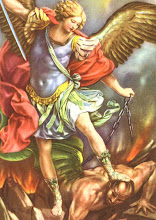
Was Jesus Married?
Did Jesus have a secret marriage with Mary Magdalene?
Mrs. Jesus
Has history been wrong for 2000 years---was there a Mrs. Jesus Christ? In, “The Jesus Family Tomb,” (The Discovery Channel’s TV documentary) director Simcha Jacobovici claims there is “evidence” that Jesus and Mary Magdalene indeed were married and had a son named Judah (To see what scholars say about Jacobovici’s “evidence” see, "The Jesus Family Tomb" article ). Jacobovici is not the first to postulate a possible romantic relationship between Jesus and Mary. The movie, The Last Temptation of Christ, and books such as Holy Blood, Holy Grail, and The Da Vinci Code, made a secret relationship between Jesus and Mary central to their themes.
The Da Vinci Code begins with a page of facts that makes the fictional novel appear to be true in all its assertions. The book has broken all records on the New York Times best-sellers list, and has been followed by a blockbuster movie. Author Dan Brown’s clever weaving of fact with fiction has convinced many readers that Jesus and Mary Magdalene really were married and had a child (see “Mona Lisa’s Smirk”). But is this romantic assertion just hype to sell books and movies, or is it supported by historical evidence.
Mysterious Mary
Before we examine the evidence for any possible romance between Jesus and Mary Magdalene, let’s look into this person of Mary from the little Galilean town of Magdala. To begin we ask the question, what ancient documents shed light upon her character and her relationship with Jesus of Nazareth?
The New Testament gospels are the oldest written records of Mary of Magdala. In the gospels Mary is depicted as a woman who Jesus healed of demon possession. The gospels (Matthew, Mark, Luke, & John) present Mary as a follower of Jesus who listened to his teaching, provided for his financial needs, witnessed his crucifixion, and three days later was first to see him alive.
Some have said Mary Magdalene was a prostitute, but neither the apostles nor the early church speak of her as more than one of Jesus’ close disciples. The idea that she was a prostitute originated in the sixth century, when Pope Gregory I identified her as both the woman spoken of in Luke 7:37, and the woman who washed Jesus’ feet with her hair.
Although the pope’s view was probably influenced by the fact that Jesus had cast seven demons out of her, no biblical scholar is able to make the connection of Mary Magdalene with the woman in Luke’s passage. Additionally, the New Testament gospels don’t even hint of anything romantic or sexual between Jesus and Mary.
So where do conspiracy theorists get the idea? Why all the speculation? For that we turn to documents written 100-200 years after the New Testament gospels by a non-Christian cult called the Gnostics [see Gnostic Gospels]. These writings are not part of the New Testament, and were rejected by early Christians as heretical. Those who write of a romantic relationship between Jesus and Mary cite a few passages from two of those writings, the Gospel of Mary and the Gospel of Philip. Let’s look at those passages.
The Gospel of Mary (Magdalene)
The notion that Mary Magdalene was special to Jesus is taken primarily from the Gospel of Mary. This Gnostic gospel is not part of the New Testament, and was written by an unknown author in the last half of the second century, or about one hundred fifty years after Jesus’ death. No eyewitnesses, including Mary, would have been alive at the time it was written (about 150 A. D.). Such a late date means the Gospel of Mary could not have been written by an eyewitness of Jesus, and no one knows who wrote it.
One verse in the Gospel of Mary refers to Mary Magdalene as Jesus’ favorite disciple, saying he loved Mary “more than us (meaning his disciples).” In another verse Peter supposedly told Mary, “Sister, we know the savior loved you more than any other woman.” Yet nothing written in The Gospel of Mary speaks of a romance or sexual relationship between Mary Magdalene and Jesus.
The Gospel of Philip
The Da Vinci Code bases its claim that Jesus and Mary were married and had a child primarily upon one solitary verse in the Gnostic Gospel of Philip that indicates Jesus and Mary were “companions”. This verse reads: (Brackets appear where words of the document are missing or illegible)
Three women always walked with the master: Mary his mother, [] sister, and Mary of Magdala, who is called his companion (koinonos). For “Mary” is the name of his sister, his mother and his companion (koinonos).
In The Da Vinci Code, fictional expert Sir Leigh Teabing proffers that the word for companion (koinonos) could mean spouse. But according to scholars, that is an unlikely interpretation. To begin, the word generally used for wife in New Testament Greek is “gune”, not “koinonos.” Ben Witherington III, writing in Biblical Archaeological Review, addressed this very point:
There was another Greek word, gune, which would have made this clear. It is much more likely that koinonos here means “sister” in the spiritual sense since that is how it is used elsewhere in this sort of literature. In any case, this text does not clearly say or even suggest that Jesus was married, much less married to Mary Magdalene.1
There is also a single verse in the Gospel of Philip that says Jesus kissed Mary.
The companion of the [] is Mary of Magdala. The [] her more than [] the disciples, [] kissed her often on her []. The other []...said to him, “Why do you love her more than all of us?”
Greeting friends with a kiss was common in the first century, and had no sexual connotation. Professor Karen King explains in her book The Gospel of Mary Magdala, that the kiss in Philip most likely was a chaste kiss of fellowship.
But perhaps more important is the fact that the Gospel of Philip was written by an unknown author about 200 years after the New Testament eyewitness accounts (see “Is the New Testament Reliable” and “Mona Lisa’s Smirk”).
It is also important to note that, aside from these few questionable passages, there is no other historical document that even insinuates Jesus and Mary had a romantic relationship. No secular historian, Jewish historian, or early Christian historian writes even one iota about such a relationship. And since both the Gospel of Mary and the Gospel of Philip were written 100-220 years after Christ by unknown authors, their statements about Jesus and Mary need to be evaluated in context of both contemporary history and the much earlier New Testament documents.
Scholars' Verdict
But could the early church have destroyed the evidence in their attempt to rewrite the history of Jesus? Of course that’s what Jacobovici, Brown, and a host of other sensationalists are saying. But do scholars agree?
A Newsweek magazine article summarizing leading scholars’ opinions, flatly states that the notion Jesus and Mary Magdalene were married has no historical basis.2 Perhaps the Gnostics felt the New Testament was a bit shy on romance and decided to sauce it up a little. Whatever the reason, these isolated and obscure verses written 100-200 years after Christ aren’t much to base a conspiracy theory upon. Interesting reading perhaps, but definitely not history.
But some remain unconvinced. Perhaps they just want to make history more interesting. Award-winning television journalist Frank Sesno asked a panel of historical scholars about the fascination people have with conspiracy theories. Professor Stanley Kutler from the University of Wisconsin replied, “We all love mysteries – but we love conspiracies more.”3
Perhaps all the hype about Jesus and Mary has more to do with antagonists to Christianity trying to humanize the man who Christians from the very beginning have called “God.” (To read more about how the early Christians viewed Jesus see “Mona Lisa’s Smirk”). For example, the apostle Paul said of Jesus Christ,
Though he was God, he did not demand and cling to his rights as God. He made himself nothing; he took the humble position of a slave and appeared in human form” (Philippians 2:6, 7a).
John, an eyewitness, and one of Jesus’ closest disciples, said of him,
In the beginning the word already existed. He was with God, and he was God….He created everything there is….so the Word became human and lived here on earth among us. (portions of John 1:1-3, 14).
The greatest question of our time is not whether Jesus and Mary Magdalene were married, but, who is the real Jesus Christ? Was he just an exceptional man, or was he God in the flesh, as Paul, John, and his other disciples believed? (See “Jesus Complex” for further reading on the identity of Jesus Christ).
Click here to take a look at the evidence for the most fantastic claim ever made---the resurrection of Jesus Christ!
Was there a "Da Vinci" Conspiracy?
“Mona Lisa’s Smirk” investigates the world’s leading conspiracy theory about Jesus Christ. Were Jesus and Mary Magdalene married? Did Constantine order the destruction of the true records of Jesus Christ reinventing him into the God Christians worship today?
Click here to discover the truth about The Da Vinci Code
Can Jesus Bring Meaning to Life?
“Why Jesus” looks at the question of whether or not Jesus is relevant today. Can Jesus answer the big questions of life: “Who am I?” “Why am I here?” And, “Where am I going?” Dead cathedrals and crucifixes have led some to believe that he can’t, and that Jesus has left us to cope with a world out of control. But Jesus made claims about life and our purpose here on earth that need to be examined before we write him off as uncaring or impotent. This article examines the mystery of why Jesus came to earth.
Click here to discover how Jesus can bring meaning to life.
Endnotes
1 Ben Witherington, Biblical Archaeology Review, (2004), "Reviews," 30 [3]:58-61, May/June.
2 Barbara Kantrowitz and Anne Underwood, "Decoding 'The Da Vinci Code,' " Newsweek, December 8, 2003, 54.
3 Stanley Kutler, interview with Frank Sesno, "The Guilty Men: An Historical Review," History Channel, April 6, 2004.
http://y-jesus.com/jesus_married.php?gclid=COWh-6CWmpECFRHyXgodGTGDOw
lunedì 28 gennaio 2008

L.GARDNER BLOODLINE THEORY IS BASED ON B.THIERING ONE'S
Mary Magdalene
© 2007 Dr. Barbara Thiering
The information about Mary Magdalene has been given in various contexts in other parts of this site, but I have been asked to bring it all together in a biography. It is undoubtedly a matter of the greatest popular interest at the present time. What is given here is the historical evidence, to be distinguished from the myth that is rapidly forming.
To begin at the beginning:
Christianity began in the movement called Essene, one of the major world-views among Jews in the 1st centuries BC and AD. They had been very much influenced by Greek thought, which regarded sexual activity as debasing.
Essenes believed that the holiest kind of life was one that renounced sex and marriage altogether, practiced by monastics and hermits. But they had another purpose also, to preserve the great dynasties of the Zadokite priests and the Davids, who had once ruled the Jerusalem temple but had now lost power. They solved the problem by instituting a second order, one that allowed sex only for the sake of having sons.
The dynasts lived normally in monasteries, but when they reached their late thirties they left temporarily for a marriage, preferably with a young girl in her teens. A first wedding permitted them to live together for a trial marriage, then when the girl was three months pregnant, there was a second wedding from which there could be no divorce. The man returned to the monastery after the birth, to come back to his wife only after intervals of years for further conceptions. The girl lived in a female community, continuing as a nun.
The rigors of the sexual discipline caused occasional breaches. One such lapse gave rise to the story of the Virgin Birth. Joseph was a descendant of the Davids, destined to regain the kingship if the Essenes achieved their aim of returning to power. He had entered the long betrothal period preceding the first wedding, with the young girl Mary. Only a few months before their wedding, during the restrained courtship that was permitted, they had given way to passion, and Jesus was conceived. From the strict Essene viewpoint he was illegitimate, and could not inherit. From a more liberal viewpoint such as was held by some asssociated ascetics, he was legitimate, and their political purposes would be served if he became king. By the use of double meanings, the word Virgin could simply mean a nun, as Mary had been. Popular Greek thought welcomed the story of the Virgin Birth that was composed to cover what had actually happened.
Jesus when he reached maturity was bound by the same rule, and there was no pre-nuptial sex in his case. His bride was Mary Magdalene. Several facts about her become apparent from the pesher, the device for giving yet concealing the actual history. One was that she was 27 years old when she married Jesus, not a young girl, and there is an indication that she had been married previously and was a widow. She had been married to a priest, and so came within the rules for permissible Essene marriages.
The other fact about her, expressed by saying that she had had “seven demons” was that she belonged to the political party of the Magians, and she shared their vigorous militant ideals. Magians were Essenes who had scholarly schools in the Diaspora, but held looser views on morality that earned them the title of “seekers-after-smooth-things”. Its leader in the time of Jesus was Simon Magus, and Jesus and Mary Magdalene were close friends of Simon and his mistress Helena. Helena like Simon appears under many pseudonyms, one of them Martha.
In March 33 AD, the season of the crucifixion, Mary Magdalene was three months pregnant with Jesus’ child. Their second wedding took place on the Wednesday before Good Friday, Mary figuring as the woman with the alabaster cruse of ointment. Jesus underwent crucifixion for the reason that he was a political associate of the anti-Roman militants Simon Magus and Judas Iscariot. Jesus and Simon were rescued by a conspiracy of their friends. From that central experience the story of the Resurrection arose. It had the same character as the Virgin Birth, told in a double way that revealed yet concealed what had actually happened.
A daughter was born to Mary Magdalene in September 33 AD. She was named Tamar, the name of the virgin daughter of King David. In its Greek form it was Damaris. She appeared under that name at a later stage of Acts, at the time of her marriage to Paul, who by then was the closest confidant of Jesus.
Two sons were born next, at the intervals of time required by the Essene rule. Jesus Justus, named after his father with the added title meaning that he was the David crown prince, was born in June, 37 AD, and another son, whose name is not given, was born in March 44 AD.
That same season, March 44 AD, was that of the real climax of the history. It was the season of the assassination of Agrippa I, whose presence during the gospel period had been one of the factors causing Simon Magus and Jesus to be at enmity with him. His young son Agrippa II became his successor. He had been tutored by Paul, with the result that Christianity became established in his court. At the same time, the tolerance of the benign emperor Claudius caused many to change their politics. Jesus with Paul joined the pro-Roman court of Agrippa II, while Simon Magus remained with the militants, operating from their base in Damascus, but working also on the Tiber Island in Rome.
For Mary Magdalene, committed to the military method of spreading Judaism against Roman paganism, Jesus had betrayed all they had worked for. She separated from him and initiated a divorce, soon after the birth of their third child. The legalities of the divorce were carried out by Paul, who as a former Pharisee condoned divorce. He also officiated at the second wedding of Jesus, to Lydia. It took place in Philippi in Macedonia, for the Christian party was by now based in Europe, looking to Rome rather than Jerusalem.
What happened to Mary Magdalene? Since Simon Magus remained active in Rome, in a rival mission to that of the Christians under Peter, it is likely that she took comfort by remaining with Simon, in the form of mission that she believed was the true one. The history of John Mark gives a clue to her movements. He had been the “eunuch” for Jesus’ first marriage, a celibate who acted for both husband and wife during their separations. He departed from the Christians at the time of the schism with Simon Magus, and had no further association with Jesus, his place as “eunuch” being taken by Luke for the second marriage. In 58 AD John Mark under his own name of Eutychus was reconciled with Paul and the Christians, as told in the “miracle” of the “raising from the dead” of Eutychus. It is possible that Mary Magdalene had died, although of course there could be other reasons for the change.
Had she gone to the south of France, as recent writers exploiting their version of the hidden history have claimed? My answer would be No, when the evidenced political history is taken into account.
There would be good reason for believing that the descendants of Jesus were driven from Rome to the south of France at the time of the Diocletian persecutions of the 90’s. Estates of the Herods had been established there, in Lyons and Vienne, by earlier Herods in their banishment. Mission would be continued from there, in the revised form that had been brought about by Jesus and Paul.
But they remained remote mission stations, bases for a further drive into the darkest untamed regions of the world such as France, and that barbaric region at the ends of the earth, England. The great leaders of the ascetic orders did not risk going there themselves, but sent servants using their name because they taught their doctrine. Joseph of Arimathea, who was James the brother of Jesus, did not go to England himself. He died in Jerusalem in 62 AD. But he had sent a servant who formed communities holding a sacred meal, with the revered cup of wine that signified initiation.
Mary Magdalene would have remained the titular head of female ascetic communities in the Magian tradition, stemming from some of the Herodian houses in the south of France. They had been established very early, and would have looked to her as their remote great leader, a visionary figure from whom their inspiration came. That would be the reason for the persistence of the tradition about her in those regions. The slender clues have, however, been built up in the interests of the lucrative tourist trade, a familiar phenomenon in our own times.
With better intentions have been those feminists who have seen reason for a cult of Mary Magdalene, as a corrective to the denigration of women that has always been practiced by the Church. Some gnostic literature upholds her as a teacher, and she would have filled that role because women were appointed as the instructors of Gentiles in their first stages of education towards initiation. Gentiles were called “children”, to whom the women were “Mothers”.
But have we not moved beyond the cult of human beings, both of Jesus or of any female? Is it not a form of idolatry to worship representatives of ourselves? “God” is far greater than the human. We are now in the midst of one of the major theological crises, the challenging of the notion of “God” that itself is a human construct. It also has its regrettable oversimplifications, but it is timely.
--------------------------------------------------------------------------------
Continue to next entry in Biographies: Agrippa II & Bernice or click title above to return to menu.
(if you are using the "without frames" entry, please return to previous page containing the menu via the "Back" browser button.)
--------------------------------------------------------------------------------
Information from this page is subject to copyright at:
The Pesher of Christ web site (with frames)
(without frames)
© 2007 Dr. Barbara Thiering
The information about Mary Magdalene has been given in various contexts in other parts of this site, but I have been asked to bring it all together in a biography. It is undoubtedly a matter of the greatest popular interest at the present time. What is given here is the historical evidence, to be distinguished from the myth that is rapidly forming.
To begin at the beginning:
Christianity began in the movement called Essene, one of the major world-views among Jews in the 1st centuries BC and AD. They had been very much influenced by Greek thought, which regarded sexual activity as debasing.
Essenes believed that the holiest kind of life was one that renounced sex and marriage altogether, practiced by monastics and hermits. But they had another purpose also, to preserve the great dynasties of the Zadokite priests and the Davids, who had once ruled the Jerusalem temple but had now lost power. They solved the problem by instituting a second order, one that allowed sex only for the sake of having sons.
The dynasts lived normally in monasteries, but when they reached their late thirties they left temporarily for a marriage, preferably with a young girl in her teens. A first wedding permitted them to live together for a trial marriage, then when the girl was three months pregnant, there was a second wedding from which there could be no divorce. The man returned to the monastery after the birth, to come back to his wife only after intervals of years for further conceptions. The girl lived in a female community, continuing as a nun.
The rigors of the sexual discipline caused occasional breaches. One such lapse gave rise to the story of the Virgin Birth. Joseph was a descendant of the Davids, destined to regain the kingship if the Essenes achieved their aim of returning to power. He had entered the long betrothal period preceding the first wedding, with the young girl Mary. Only a few months before their wedding, during the restrained courtship that was permitted, they had given way to passion, and Jesus was conceived. From the strict Essene viewpoint he was illegitimate, and could not inherit. From a more liberal viewpoint such as was held by some asssociated ascetics, he was legitimate, and their political purposes would be served if he became king. By the use of double meanings, the word Virgin could simply mean a nun, as Mary had been. Popular Greek thought welcomed the story of the Virgin Birth that was composed to cover what had actually happened.
Jesus when he reached maturity was bound by the same rule, and there was no pre-nuptial sex in his case. His bride was Mary Magdalene. Several facts about her become apparent from the pesher, the device for giving yet concealing the actual history. One was that she was 27 years old when she married Jesus, not a young girl, and there is an indication that she had been married previously and was a widow. She had been married to a priest, and so came within the rules for permissible Essene marriages.
The other fact about her, expressed by saying that she had had “seven demons” was that she belonged to the political party of the Magians, and she shared their vigorous militant ideals. Magians were Essenes who had scholarly schools in the Diaspora, but held looser views on morality that earned them the title of “seekers-after-smooth-things”. Its leader in the time of Jesus was Simon Magus, and Jesus and Mary Magdalene were close friends of Simon and his mistress Helena. Helena like Simon appears under many pseudonyms, one of them Martha.
In March 33 AD, the season of the crucifixion, Mary Magdalene was three months pregnant with Jesus’ child. Their second wedding took place on the Wednesday before Good Friday, Mary figuring as the woman with the alabaster cruse of ointment. Jesus underwent crucifixion for the reason that he was a political associate of the anti-Roman militants Simon Magus and Judas Iscariot. Jesus and Simon were rescued by a conspiracy of their friends. From that central experience the story of the Resurrection arose. It had the same character as the Virgin Birth, told in a double way that revealed yet concealed what had actually happened.
A daughter was born to Mary Magdalene in September 33 AD. She was named Tamar, the name of the virgin daughter of King David. In its Greek form it was Damaris. She appeared under that name at a later stage of Acts, at the time of her marriage to Paul, who by then was the closest confidant of Jesus.
Two sons were born next, at the intervals of time required by the Essene rule. Jesus Justus, named after his father with the added title meaning that he was the David crown prince, was born in June, 37 AD, and another son, whose name is not given, was born in March 44 AD.
That same season, March 44 AD, was that of the real climax of the history. It was the season of the assassination of Agrippa I, whose presence during the gospel period had been one of the factors causing Simon Magus and Jesus to be at enmity with him. His young son Agrippa II became his successor. He had been tutored by Paul, with the result that Christianity became established in his court. At the same time, the tolerance of the benign emperor Claudius caused many to change their politics. Jesus with Paul joined the pro-Roman court of Agrippa II, while Simon Magus remained with the militants, operating from their base in Damascus, but working also on the Tiber Island in Rome.
For Mary Magdalene, committed to the military method of spreading Judaism against Roman paganism, Jesus had betrayed all they had worked for. She separated from him and initiated a divorce, soon after the birth of their third child. The legalities of the divorce were carried out by Paul, who as a former Pharisee condoned divorce. He also officiated at the second wedding of Jesus, to Lydia. It took place in Philippi in Macedonia, for the Christian party was by now based in Europe, looking to Rome rather than Jerusalem.
What happened to Mary Magdalene? Since Simon Magus remained active in Rome, in a rival mission to that of the Christians under Peter, it is likely that she took comfort by remaining with Simon, in the form of mission that she believed was the true one. The history of John Mark gives a clue to her movements. He had been the “eunuch” for Jesus’ first marriage, a celibate who acted for both husband and wife during their separations. He departed from the Christians at the time of the schism with Simon Magus, and had no further association with Jesus, his place as “eunuch” being taken by Luke for the second marriage. In 58 AD John Mark under his own name of Eutychus was reconciled with Paul and the Christians, as told in the “miracle” of the “raising from the dead” of Eutychus. It is possible that Mary Magdalene had died, although of course there could be other reasons for the change.
Had she gone to the south of France, as recent writers exploiting their version of the hidden history have claimed? My answer would be No, when the evidenced political history is taken into account.
There would be good reason for believing that the descendants of Jesus were driven from Rome to the south of France at the time of the Diocletian persecutions of the 90’s. Estates of the Herods had been established there, in Lyons and Vienne, by earlier Herods in their banishment. Mission would be continued from there, in the revised form that had been brought about by Jesus and Paul.
But they remained remote mission stations, bases for a further drive into the darkest untamed regions of the world such as France, and that barbaric region at the ends of the earth, England. The great leaders of the ascetic orders did not risk going there themselves, but sent servants using their name because they taught their doctrine. Joseph of Arimathea, who was James the brother of Jesus, did not go to England himself. He died in Jerusalem in 62 AD. But he had sent a servant who formed communities holding a sacred meal, with the revered cup of wine that signified initiation.
Mary Magdalene would have remained the titular head of female ascetic communities in the Magian tradition, stemming from some of the Herodian houses in the south of France. They had been established very early, and would have looked to her as their remote great leader, a visionary figure from whom their inspiration came. That would be the reason for the persistence of the tradition about her in those regions. The slender clues have, however, been built up in the interests of the lucrative tourist trade, a familiar phenomenon in our own times.
With better intentions have been those feminists who have seen reason for a cult of Mary Magdalene, as a corrective to the denigration of women that has always been practiced by the Church. Some gnostic literature upholds her as a teacher, and she would have filled that role because women were appointed as the instructors of Gentiles in their first stages of education towards initiation. Gentiles were called “children”, to whom the women were “Mothers”.
But have we not moved beyond the cult of human beings, both of Jesus or of any female? Is it not a form of idolatry to worship representatives of ourselves? “God” is far greater than the human. We are now in the midst of one of the major theological crises, the challenging of the notion of “God” that itself is a human construct. It also has its regrettable oversimplifications, but it is timely.
--------------------------------------------------------------------------------
Continue to next entry in Biographies: Agrippa II & Bernice or click title above to return to menu.
(if you are using the "without frames" entry, please return to previous page containing the menu via the "Back" browser button.)
--------------------------------------------------------------------------------
Information from this page is subject to copyright at:
The Pesher of Christ web site (with frames)
(without frames)
MICHAEL OF ALBANY-HIS TRUE IDENTITY
From: "Guy Stair Sainty"
Subject: RE: michael of albany - his true identity
Date: Mon, 3 Apr 2006 11:00:23 +0200
In-Reply-To: <4989643B-4F2B-4227-9AB1-737A1B6B1548@iinet.net.au>
Oh please... The so-called documents found in the church in the south of
Francwe are all now admitted to be elaborate hoax dreamt up by a journalist
for his amusement along with a well-known fantasist who invented the
farcical story of this descent.
There is not one iota of genuine contemporary documentary evidence to
support any of this nonsense and without exception every single serious
biblical scholar, scholar of the Merovingian period and Middle Ages has
dismissed it without qualification or reservation.
There have always been looney conspiracy theories circulating, with their
proponents claiming there are secret documents trhat have been mysteriously
lost or destroyed by people trying to hide something or other. People used
ot believe the earth was flat and there are still small groups pretending
that NASA faked the moon landings. Nothing will persuade them otherwise.
Historical research proposing new radical theories based on secondary
sources is nearly always completely worthless. Historians are trained to
look at contemporary documents and archaeological records. There is
absolutely nothing credible to support these ideas, and stories about
Rosslyn Church, the Templars, secret descents, etc, are pure invention.
I am not trying to be mean but if you honestly consider yourself a serious
student of genealogy or history, demand to see the documentary evidence.
Otherwise do not waste any more time giving credence to these poor deluded
fantasists.
Guy
-----Original Message-----
From: Trish Lawrence [mailto:charli@iinet.net.au]
Sent: 03 April 2006 02:05
To: GEN-ROYAL-L@rootsweb.com
Subject: Re: michael of albany - his true identity
Guy
I have to say when I first HBHG I was very sceptical, but I didn't
dismiss them outrightly, I went looking for other works that might
support their theories. There is theological work that does so, as
well as genealogical work. So lets not throw out the baby with the
bathwater.
Trish
On 03/04/2006, at 3:57 AM, Guy Stair Sainty wrote:
> I doubt it will be the last we shall hear of the wretched fellow -
> unfortunately the same kind of conspiracy theorists who gave
> credence to the
> harmless ravings of the authors of HBHG and faithfully follow the
> Word of
> Dan Brown are likely to simply believe this is just another
> conspiracy.
>
> Guy Stair sainty
>
> -----Original Message-----
> From: Leo van de Pas [mailto:leovdpas@netspeed.com.au]
> Sent: 02 April 2006 15:36
> To: GEN-ROYAL-L@rootsweb.com
> Subject: michael of albany - his true identity
>
>
>> Overwhelming evidence against Michael of Albany
>>
>> http://www.sundayherald.com/54904
>>
> Many years ago I corresponded with Laurence Gardner, author of "The
> Holy
> Blood and The Holy Grail", about the genealogical trees, as I
> disagreed with
>
> several details. We had a very interesting and pleasant exchange. He
> accepted some of my remarks but stood firm on those aspects
> relevant to the
> story. After a while he advised me that the corrected trees had
> been passed
> on to Prince Michael of Albany for his "The Forgotten Monarchy of
> Scotland".
>
> As a result I received an acknowledgement in this book.
>
> "The Stuarts last Secret" by Peter Pininski made clear that the
> claims of
> Michael of Albany are spurious and the above newspaper article
> could/should
> be the last we hear of a Prince Michael of Albany.
>
> Best wishes
> Leo van de Pas
> Canberra, Australia
>
>
> ==== GEN-ROYAL Mailing List ====
> For information on subscribing and unsubscribing from GEN-ROYAL,
> see the GEN-ROYAL FAQ at;
>
>
>
> ==== GEN-ROYAL Mailing List ====
> For information on subscribing and unsubscribing from GEN-ROYAL,
> see the GEN-ROYAL FAQ at;
==== GEN-ROYAL Mailing List ====
For information on subscribing and unsubscribing from GEN-ROYAL,
see the GEN-ROYAL FAQ at;
Subject: RE: michael of albany - his true identity
Date: Mon, 3 Apr 2006 11:00:23 +0200
In-Reply-To: <4989643B-4F2B-4227-9AB1-737A1B6B1548@iinet.net.au>
Oh please... The so-called documents found in the church in the south of
Francwe are all now admitted to be elaborate hoax dreamt up by a journalist
for his amusement along with a well-known fantasist who invented the
farcical story of this descent.
There is not one iota of genuine contemporary documentary evidence to
support any of this nonsense and without exception every single serious
biblical scholar, scholar of the Merovingian period and Middle Ages has
dismissed it without qualification or reservation.
There have always been looney conspiracy theories circulating, with their
proponents claiming there are secret documents trhat have been mysteriously
lost or destroyed by people trying to hide something or other. People used
ot believe the earth was flat and there are still small groups pretending
that NASA faked the moon landings. Nothing will persuade them otherwise.
Historical research proposing new radical theories based on secondary
sources is nearly always completely worthless. Historians are trained to
look at contemporary documents and archaeological records. There is
absolutely nothing credible to support these ideas, and stories about
Rosslyn Church, the Templars, secret descents, etc, are pure invention.
I am not trying to be mean but if you honestly consider yourself a serious
student of genealogy or history, demand to see the documentary evidence.
Otherwise do not waste any more time giving credence to these poor deluded
fantasists.
Guy
-----Original Message-----
From: Trish Lawrence [mailto:charli@iinet.net.au]
Sent: 03 April 2006 02:05
To: GEN-ROYAL-L@rootsweb.com
Subject: Re: michael of albany - his true identity
Guy
I have to say when I first HBHG I was very sceptical, but I didn't
dismiss them outrightly, I went looking for other works that might
support their theories. There is theological work that does so, as
well as genealogical work. So lets not throw out the baby with the
bathwater.
Trish
On 03/04/2006, at 3:57 AM, Guy Stair Sainty wrote:
> I doubt it will be the last we shall hear of the wretched fellow -
> unfortunately the same kind of conspiracy theorists who gave
> credence to the
> harmless ravings of the authors of HBHG and faithfully follow the
> Word of
> Dan Brown are likely to simply believe this is just another
> conspiracy.
>
> Guy Stair sainty
>
> -----Original Message-----
> From: Leo van de Pas [mailto:leovdpas@netspeed.com.au]
> Sent: 02 April 2006 15:36
> To: GEN-ROYAL-L@rootsweb.com
> Subject: michael of albany - his true identity
>
>
>> Overwhelming evidence against Michael of Albany
>>
>> http://www.sundayherald.com/54904
>>
> Many years ago I corresponded with Laurence Gardner, author of "The
> Holy
> Blood and The Holy Grail", about the genealogical trees, as I
> disagreed with
>
> several details. We had a very interesting and pleasant exchange. He
> accepted some of my remarks but stood firm on those aspects
> relevant to the
> story. After a while he advised me that the corrected trees had
> been passed
> on to Prince Michael of Albany for his "The Forgotten Monarchy of
> Scotland".
>
> As a result I received an acknowledgement in this book.
>
> "The Stuarts last Secret" by Peter Pininski made clear that the
> claims of
> Michael of Albany are spurious and the above newspaper article
> could/should
> be the last we hear of a Prince Michael of Albany.
>
> Best wishes
> Leo van de Pas
> Canberra, Australia
>
>
> ==== GEN-ROYAL Mailing List ====
> For information on subscribing and unsubscribing from GEN-ROYAL,
> see the GEN-ROYAL FAQ at
>
>
>
> ==== GEN-ROYAL Mailing List ====
> For information on subscribing and unsubscribing from GEN-ROYAL,
> see the GEN-ROYAL FAQ at
==== GEN-ROYAL Mailing List ====
For information on subscribing and unsubscribing from GEN-ROYAL,
see the GEN-ROYAL FAQ at
THE MAN WHO LIED TO BE KING
The Man who lied to be King..or not a proper Charlie.
Take your pick some of us have known for a very long time that Roger Lafosse's claims were bogus,but,it is good to see that although the wheels of British law move slowly,it is still very efficient and fair.
Below is a report from several interested people who believe in the importance of Scottish History. feel free to add your own comments by leaving a reply...editor
Latest news on the infamous "Prince Michael of Albany" who has made a name for himself by claiming to be descended from bonnie Prince Charlie. (And, FYI, a friend of mine says he also saw "Prince Michael" on a recent Travel Channel show about the _DaVinci Code_ where he makes the incredible claim to be descended from Jesus Christ!).
From this month's Scottish Banner:
"A Belgian who claims to be the king of Scotland is set to be kicked out of the country after losing his British citizenship. Michael Lafosse, who calls himself HRH Prince Michael of Albany, is also facing fraud charges over his application for a British passport in June 2004. Lafosse, 48, who claims he is a direct descendant of Bonnie Prince Charlie, has been under investigation by the Home Office for six months.
"The former gift shop worker and waiter ignored more than 20 letters from investigators to his home in Edinburgh's New Town. They wanted him to explain why he submittted a forged birth certificate in support of his British citizenship application five years ago. The probe was launched after information was given to investigators at the UK passport office in Glasgow in December by a historical researcher.
"A Home Office insider said yesterday 'Lafosse was given every chance possible to plead his case but he just ignored our letters. He has now had his British citizenship revoked and he will also lose his right to a British passport.' Lafosse, whose claims have been labelled totally bogus by experts, is also alleged to have used a fake diplomatic passport to travel. He could not be contacted for comment at his home recently."
--
Matthew A. C. Newsome, FSA Scot
Curator of the Scottish Tartans Museum
Member of the Guild of Tartan Scholars
Homepage: http://www.albanach.org
latest developments
There is an update on Mikey Lafosse in the Sunday Mail at
/
report as follows;-
http://www.edinburghguide.com/edgforum/viewtopic.php?t=3955
Take your pick some of us have known for a very long time that Roger Lafosse's claims were bogus,but,it is good to see that although the wheels of British law move slowly,it is still very efficient and fair.
Below is a report from several interested people who believe in the importance of Scottish History. feel free to add your own comments by leaving a reply...editor
Latest news on the infamous "Prince Michael of Albany" who has made a name for himself by claiming to be descended from bonnie Prince Charlie. (And, FYI, a friend of mine says he also saw "Prince Michael" on a recent Travel Channel show about the _DaVinci Code_ where he makes the incredible claim to be descended from Jesus Christ!).
From this month's Scottish Banner:
"A Belgian who claims to be the king of Scotland is set to be kicked out of the country after losing his British citizenship. Michael Lafosse, who calls himself HRH Prince Michael of Albany, is also facing fraud charges over his application for a British passport in June 2004. Lafosse, 48, who claims he is a direct descendant of Bonnie Prince Charlie, has been under investigation by the Home Office for six months.
"The former gift shop worker and waiter ignored more than 20 letters from investigators to his home in Edinburgh's New Town. They wanted him to explain why he submittted a forged birth certificate in support of his British citizenship application five years ago. The probe was launched after information was given to investigators at the UK passport office in Glasgow in December by a historical researcher.
"A Home Office insider said yesterday 'Lafosse was given every chance possible to plead his case but he just ignored our letters. He has now had his British citizenship revoked and he will also lose his right to a British passport.' Lafosse, whose claims have been labelled totally bogus by experts, is also alleged to have used a fake diplomatic passport to travel. He could not be contacted for comment at his home recently."
--
Matthew A. C. Newsome, FSA Scot
Curator of the Scottish Tartans Museum
Member of the Guild of Tartan Scholars
Homepage: http://www.albanach.org
latest developments
There is an update on Mikey Lafosse in the Sunday Mail at
report as follows;-
http://www.edinburghguide.com/edgforum/viewtopic.php?t=3955
REPORT ON THE PEDIGREE OF MICHEL LA FOSSE STYLED PRINCE MICHAEL OF ALBANY
Irish Chiefs
Back to Homepage
Report on the Pedigree of Michel Lafosse,
Styled Prince Michael of Albany
Michel Lafosse, also known as Prince Michael of Albany, is not an Irish Chief or Prince, but by virtue of his claim to be the Stuart heir to the Throne of Scotland he does appropriate some Irish lineage and therefore deserves attention. Who is Lafosse and what is the nature of his claim? By his own account, Lafosse was born in Belgium in 1958, has made Scotland his permanent home since 1976, and in addition to being the 7th Count of Albany, he goes by the style of Alexander IV, Head of the Royal House of Stuart (or Stewart) and Prince de jure of Scotland. Other more exotic titles include Titular Prince of France and Poland, Head of the Sacred Kindred of Saint Columba, Archpriest of the Celtic Apostolic Church, President of the European Council of Princes, Knight Grand Commander, The Chivalric Military Order of the Temple of Jerusalem, and much more. All laid these claims were laid out on Lafosse's website at http://mediaquestusa.com/Michael/pmintro.htm, and later at http://www.royalhouseofstewart.org.uk/, both of which sites are now removed (some of the older content may be accessed via the Wayback Machine web archive).
One of Lafosse's principal supporters has been the author Laurence Gardner, who styles himself The Chevalier Labhràn de St Germain. Gardner has published a book whose message is clear from its title, Bloodline of the Holy Grail: The Hidden Lineage of Jesus Revealed (Element Books, Shaftesbury, Dorset, and Rockport, Massachussets, 1996). In 400 pages of text and over 50 pages of genealogical charts, Gardner purports to trace a direct line of descent from Jesus Christ and his alleged consort Mary Magdalene to one Lionel, said to be a near contemporary of the fabled King Arthur whose death is placed in 603 AD. Lionel is claimed to be the ancestor of Walter FitzAlan, 1st High Steward of Scotland, who died in 1177 and whose descendant became King Robert II of Scotland in 1371 (Bloodline of the Holy Grail, pages 236-47, 279-80, 424).
The Stuarts of course succeeded to the Throne of England in 1603 following the death of the childless Elizabeth I, when James VI of Scotland became also James I of England. The vicissitudes of the later Stuarts in the wake of the overthrow of James II in 1688 are well known, culminating in the last doomed attempt of Prince Charles Edward Stuart, 'Bonny Prince Charlie', to restore the Dynasty during the Jacobite Rebellion of 1745. Now Lafosse and his supporters declare that Prince Charles contracted a second and hitherto concealed marriage with a Marguerite O'Dea d'Audibert in 1785, from whom Lafosse is allegedly descended in the maternal line. Noel McFerran's critique of these and other claims of Lafosse can be read at http://members.rogers.com/jacobites/essays/lafosse.htm, and there is another critical article by Guy Stair Sainty at http://www.chivalricorders.org/royalty/fantasy/stuart.htm
The royal claims of Michel Lafosse are very similar to the now exploded pretences of Terence MacCarthy, who purported to be 'The MacCarthy Mór, Prince of Desmond'. As with MacCarthy, I decided it would be a good idea to start by checking the most recent vital certificates relating to Lafosse's family, copies of which he had helpfully placed on his website, but which were later removed. The first certificate states that Lafosse was born in Brussels on 21 April 1958 in the Ville de Bruxelles district, and that his parents were Baron Gustave Joseph Fernand Clément Lafosse and Princess Renée Julienne Stewart. The second certificate states that Lafosse's grandparents Prince Julius Joseph Jacques Stewart and Princess Germania Elisa Segers were married in 1932, again in Brussels.
It seemed advisable to verify these documents, and so a letter of enquiry was sent on 12 April 2002 to the Registrar's Office, Boulevard Anspach 6, 1000 Bruxelles, Belgique. A reply was received by e-mail on 19 April, signed by the Conseiller Etat Civil, which stated bluntly that the above birth and marriage certificates were false ('sont des faux'), and furthermore that Michel Lafosse was born elsewhere in Brussels. Gordon MacGregor Comrie kindly supplied the copy of of Lafosse's true birth certificate below, which shows that he was indeed born in Brussels on 21 April 1958 but in the Watermael-Boitsfort district, with recorded first names Michel Roger, and that his parents are named simply as Gustave Joseph Clément Fernand Lafosse, a shopkeeper, and Renée Julienne Dée, a business employee, with no indication of any noble status whatsoever. Again, it was considered necessary to check that this second certificate was definitely in order, so on 25 July 2002 an enquiry was sent to the Etat Civil, Commune de Watermael-Boitsfort, Place Gilson 1, 1170 Bruxelles, Belgique. A reply was received on 9 August confirming that the certificate below was authentic, the words used being, 'Le certificat en question est une copie conforme à l'original'.
At a relatively late stage in research the writer found that a thorough report exposing Michel Lafosse as a fraud had been compiled in Scotland as long ago as 1980 by one Jack S MacDonald, the text of which may be read at http://priory-of-sion.com/posd/lafosse/lafosseoriginals.html. MacDonald established that the birth certificate of 'Prince Michael' was a forgery, that other documentation presented by the claimant was also fabricated, and concluded that he was 'a forger and a fraud'. The latter site provides the interesting information that MacDonald's report was commissioned by 'a group of the Scottish Patriots which included Wendy Wood, A J Stewart, Nigel Tranter and others', and states that being 'told fairy stories by his grandmother is what seems to have inspired Michel Lafosse into becoming the future "Prince Michael of Albany"'. It is remarkable what little effect MacDonald's research appears to have had, although a number of individuals in Scotland and abroad kept the matter in view over the years. Exposing bogus claimants to titles is a complex, time-consuming and often frustrating task, and the writer has found that while a report stating the genealogical facts is an essential element, it is usually not sufficient in itself to settle the issue.
It was noted that in 2001 Lafosse received from the Home Office a certificate of naturalisation as a British citizen, using the name Michael James Alexander Stewart of Albany, which document is reproduced below (copy courtesy of Rafal Heydel-Mankoo at http://www.geocities.com/rafalhm/lafosse.html).
It will be noted firstly that the certificate 'does not certify the accuracy of the personal particulars, which are supplied by the person who made the application'. However, it can be seen that there is a also a section 'Name at birth if different'. It has been demonstrated above that the applicant's name on his authentic birth certificate is Michel Roger Lafosse, and it was a serious omission not to have notified this to the Home Office when applying for naturalisation.
While as indicated above, careful research is required, a definitive media exposure is usually also needed to topple hoaxers such as Terence MacCarthy and Michel Lafosse. While there had been intermittent media coverage over the years, a fairly thorough exposure of the spurious claims of Michel Lafosse aka 'Prince Michael of Albany' appeared in the Scottish Sunday Herald of 2 April 2006: http://www.sundayherald.com/54904 The article deals with the false birth certificate and the irregular naturalisation certificate, mentioning also a passport obtained using questionable documents and a diplomatic passport issued in the name of the 'Sovereign Order of St John of Jerusalem'. It is understood that the Home Office initiated proceedings against Lafosse in relation to the false documentation presented in support of his citizenship application, and that charity regulators were also investigating his fund raising activities. In late July 2006 it was reported that Lafosse had fled Scotland and moved back to Belgium to live with his mother (Sunday Mail, 23 July 2006), and his website was taken down. Thus appears to have ended the remarkable decades-long hoax of Michel Lafosse, the so-called Prince Michael of Albany, although it remains to be seen whether the Belgian authorities will want to take proceedings in relation to forgery of vital certificates issued within their jurisdiction.
Sean Murphy MA
Centre for Irish Genealogical and Historical Studies
1 May 2002, last updated 6 August 2006
--------------------------------------------------------------------------------
http://homepage.eircom.net/%257Eseanjmurphy/chiefs/lafosse.htm
Back to Homepage
Report on the Pedigree of Michel Lafosse,
Styled Prince Michael of Albany
Michel Lafosse, also known as Prince Michael of Albany, is not an Irish Chief or Prince, but by virtue of his claim to be the Stuart heir to the Throne of Scotland he does appropriate some Irish lineage and therefore deserves attention. Who is Lafosse and what is the nature of his claim? By his own account, Lafosse was born in Belgium in 1958, has made Scotland his permanent home since 1976, and in addition to being the 7th Count of Albany, he goes by the style of Alexander IV, Head of the Royal House of Stuart (or Stewart) and Prince de jure of Scotland. Other more exotic titles include Titular Prince of France and Poland, Head of the Sacred Kindred of Saint Columba, Archpriest of the Celtic Apostolic Church, President of the European Council of Princes, Knight Grand Commander, The Chivalric Military Order of the Temple of Jerusalem, and much more. All laid these claims were laid out on Lafosse's website at http://mediaquestusa.com/Michael/pmintro.htm, and later at http://www.royalhouseofstewart.org.uk/, both of which sites are now removed (some of the older content may be accessed via the Wayback Machine web archive).
One of Lafosse's principal supporters has been the author Laurence Gardner, who styles himself The Chevalier Labhràn de St Germain. Gardner has published a book whose message is clear from its title, Bloodline of the Holy Grail: The Hidden Lineage of Jesus Revealed (Element Books, Shaftesbury, Dorset, and Rockport, Massachussets, 1996). In 400 pages of text and over 50 pages of genealogical charts, Gardner purports to trace a direct line of descent from Jesus Christ and his alleged consort Mary Magdalene to one Lionel, said to be a near contemporary of the fabled King Arthur whose death is placed in 603 AD. Lionel is claimed to be the ancestor of Walter FitzAlan, 1st High Steward of Scotland, who died in 1177 and whose descendant became King Robert II of Scotland in 1371 (Bloodline of the Holy Grail, pages 236-47, 279-80, 424).
The Stuarts of course succeeded to the Throne of England in 1603 following the death of the childless Elizabeth I, when James VI of Scotland became also James I of England. The vicissitudes of the later Stuarts in the wake of the overthrow of James II in 1688 are well known, culminating in the last doomed attempt of Prince Charles Edward Stuart, 'Bonny Prince Charlie', to restore the Dynasty during the Jacobite Rebellion of 1745. Now Lafosse and his supporters declare that Prince Charles contracted a second and hitherto concealed marriage with a Marguerite O'Dea d'Audibert in 1785, from whom Lafosse is allegedly descended in the maternal line. Noel McFerran's critique of these and other claims of Lafosse can be read at http://members.rogers.com/jacobites/essays/lafosse.htm, and there is another critical article by Guy Stair Sainty at http://www.chivalricorders.org/royalty/fantasy/stuart.htm
The royal claims of Michel Lafosse are very similar to the now exploded pretences of Terence MacCarthy, who purported to be 'The MacCarthy Mór, Prince of Desmond'. As with MacCarthy, I decided it would be a good idea to start by checking the most recent vital certificates relating to Lafosse's family, copies of which he had helpfully placed on his website, but which were later removed. The first certificate states that Lafosse was born in Brussels on 21 April 1958 in the Ville de Bruxelles district, and that his parents were Baron Gustave Joseph Fernand Clément Lafosse and Princess Renée Julienne Stewart. The second certificate states that Lafosse's grandparents Prince Julius Joseph Jacques Stewart and Princess Germania Elisa Segers were married in 1932, again in Brussels.
It seemed advisable to verify these documents, and so a letter of enquiry was sent on 12 April 2002 to the Registrar's Office, Boulevard Anspach 6, 1000 Bruxelles, Belgique. A reply was received by e-mail on 19 April, signed by the Conseiller Etat Civil, which stated bluntly that the above birth and marriage certificates were false ('sont des faux'), and furthermore that Michel Lafosse was born elsewhere in Brussels. Gordon MacGregor Comrie kindly supplied the copy of of Lafosse's true birth certificate below, which shows that he was indeed born in Brussels on 21 April 1958 but in the Watermael-Boitsfort district, with recorded first names Michel Roger, and that his parents are named simply as Gustave Joseph Clément Fernand Lafosse, a shopkeeper, and Renée Julienne Dée, a business employee, with no indication of any noble status whatsoever. Again, it was considered necessary to check that this second certificate was definitely in order, so on 25 July 2002 an enquiry was sent to the Etat Civil, Commune de Watermael-Boitsfort, Place Gilson 1, 1170 Bruxelles, Belgique. A reply was received on 9 August confirming that the certificate below was authentic, the words used being, 'Le certificat en question est une copie conforme à l'original'.
At a relatively late stage in research the writer found that a thorough report exposing Michel Lafosse as a fraud had been compiled in Scotland as long ago as 1980 by one Jack S MacDonald, the text of which may be read at http://priory-of-sion.com/posd/lafosse/lafosseoriginals.html. MacDonald established that the birth certificate of 'Prince Michael' was a forgery, that other documentation presented by the claimant was also fabricated, and concluded that he was 'a forger and a fraud'. The latter site provides the interesting information that MacDonald's report was commissioned by 'a group of the Scottish Patriots which included Wendy Wood, A J Stewart, Nigel Tranter and others', and states that being 'told fairy stories by his grandmother is what seems to have inspired Michel Lafosse into becoming the future "Prince Michael of Albany"'. It is remarkable what little effect MacDonald's research appears to have had, although a number of individuals in Scotland and abroad kept the matter in view over the years. Exposing bogus claimants to titles is a complex, time-consuming and often frustrating task, and the writer has found that while a report stating the genealogical facts is an essential element, it is usually not sufficient in itself to settle the issue.
It was noted that in 2001 Lafosse received from the Home Office a certificate of naturalisation as a British citizen, using the name Michael James Alexander Stewart of Albany, which document is reproduced below (copy courtesy of Rafal Heydel-Mankoo at http://www.geocities.com/rafalhm/lafosse.html).
It will be noted firstly that the certificate 'does not certify the accuracy of the personal particulars, which are supplied by the person who made the application'. However, it can be seen that there is a also a section 'Name at birth if different'. It has been demonstrated above that the applicant's name on his authentic birth certificate is Michel Roger Lafosse, and it was a serious omission not to have notified this to the Home Office when applying for naturalisation.
While as indicated above, careful research is required, a definitive media exposure is usually also needed to topple hoaxers such as Terence MacCarthy and Michel Lafosse. While there had been intermittent media coverage over the years, a fairly thorough exposure of the spurious claims of Michel Lafosse aka 'Prince Michael of Albany' appeared in the Scottish Sunday Herald of 2 April 2006: http://www.sundayherald.com/54904 The article deals with the false birth certificate and the irregular naturalisation certificate, mentioning also a passport obtained using questionable documents and a diplomatic passport issued in the name of the 'Sovereign Order of St John of Jerusalem'. It is understood that the Home Office initiated proceedings against Lafosse in relation to the false documentation presented in support of his citizenship application, and that charity regulators were also investigating his fund raising activities. In late July 2006 it was reported that Lafosse had fled Scotland and moved back to Belgium to live with his mother (Sunday Mail, 23 July 2006), and his website was taken down. Thus appears to have ended the remarkable decades-long hoax of Michel Lafosse, the so-called Prince Michael of Albany, although it remains to be seen whether the Belgian authorities will want to take proceedings in relation to forgery of vital certificates issued within their jurisdiction.
Sean Murphy MA
Centre for Irish Genealogical and Historical Studies
1 May 2002, last updated 6 August 2006
--------------------------------------------------------------------------------
http://homepage.eircom.net/%257Eseanjmurphy/chiefs/lafosse.htm
STUART CLAIMANTS:PRINCE MICHAEL OF ALBANY
"Prince Michael of Albany"
--------------------------------------------------------------------------------
"Prince Michael James Alexander Stewart, 7th Count of Albany, Duc d'Aquitaine, Comte de Blois, Head of the Sacred Kindred of St. Columba, Knight Grand Commander of the Order of the Temple of Jerusalem, Patron Grand Officer of the International Society of Commission Officers for the Commonwealth, President of the European Council of Princes," claims descent in the legitimate line from Charles III. The following account of him is based upon Laurence Gardner's Bloodline of the Holy Grail: The Hidden Lineage of Jesus Revealed (Element, 1996), "Prince Michael"'s The Forgotten Monarchy of Scotland (Element, 1998), and the webpage of "Prince Michael" (http://www.mediaquest.co.uk/RHSsite/RHShome.html). My own comments are in italics placed in square brackets.
According to "Prince Michael", on April 3, 1784, Pope Pius VI annulled the marriage of Charles III and his wife Louise of Stolberg-Gedern; the bases for this decree of nullity were purportedly 1. "Louise's inability to produce an heir made her unsuitable for the purpose intended", and 2. "her open involvement with Alfieri rendered her quite unworthy of her marital office."
[Louise seems never to have borne any children; she also clearly was not faithful to her marriage vows. However, anybody familiar with the marriage laws of the Catholic Church will recognise that neither of these would be sufficient cause for a decree of nullity. There is absolutely no evidence for any such annulment ever having been sought or granted. On April 3, 1784, Charles did issue a declaration in which he agreed to his wife Louise maintaining a separate permanent residence. This is altogether different from a divorce, much less an annulment. There are numerous biographies of Louise including at least three in English (by Herbert M. Vaughan, Vernon Lee, and Margaret Crosland); none of these suggest that the marriage of Charles and Louise was annulled.]
The story continues that according to the "Stuart archives in Rome and Brussels" Charles married "Marguerite Marie Therese O'Dea d'Audibert de Lussan, Comtesse de Massillan" in November 1785 in the Church of the Santi Apostoli in Rome.
[There is no collection in Rome called the "Stuart archives". The largest collections of papers of the Stuart kings-in-exile are now in England at Windsor Castle and the British Museum. A number of archival collections in Italy include some papers related to the Stuart kings. Gardner refrains from being any more specific, no doubt because he cannot be.]
[In naming "Marguerite Marie Therese O'Dea d'Audibert de Lussan" as Charles' supposed second wife "Prince Michael" begins a pattern of attributing to people the surnames of their maternal ancestors; Marguerite O'Dea may have been descended in the female line from the families of Audibert and Lussan, but she had no right to use these surnames herself. She was not a member of the great French families of Audibert or Lussan and had no right to the title "comtesse de Massilan".]
As proof of this wedding "Prince Michael" cites a Latin extract purportedly from the marriage registers of the Church of the Santi Apostoli in Rome. On his website and in his book "Prince Michael" reproduces a statement from a Belgian notary confirming the origin of the extract.
[Gardner does not explain how a Belgian notary would be able to authenticate a record supposedly in Rome!]:
Quod Heic XXVI Kal Dec. ANRS MDCCLXXXV Hospes Hospiti Carolus III Rex Mag. Brit. Fran. et Hib. Fid. Def. Porrexerit Dexteram Margaretae Mariae Tereseae Fil. Ferdinandi Dea d'Audibert de Lussan et Francescae d'Audibert de Lussan, Comitessa de Masillan, etc., Eamque, Servatis SRE Ritibus Duxerit in Matrimonium.
[The date of the document proves it to be a total fabrication. In the Roman calendar "XXVI Kal. Dec." would (if it existed) be the 25th (sic) day before the Kalends of December; this is comparable to saying the 39th of March - there is no such date! "Prince Michael" translates "XXVI Kal. Dec." as "December 26th", and thereby shows his lack of familiarity with how the Roman calendar works. "Kal. Dec.", the Kalends of December is December 1st; "II Kal. Dec." is the day before the Kalends of December, i.e. November 30th; "XVIII Kal. Dec." is the seventeenth day before the Kalends of December, i.e. November 14th. There is no "XIX Kal. Dec." (let alone a "XXVI Kal. Dec.") because the day before "XVIII Kal. Dec." is "Id. Nov.", the Ides of November.]
[The rest of the Latin, however, is accurate - for the reason that it has been copied (with only the names changed) from the inscription recording Charles' marriage to Louise of Stolberg in the Palazzo Marefoschi in Macerata. It is for that reason that the passage begins "Quod heic" (here on account of the fact that). Such an expression makes perfect sense in a monumental inscription, but is meaningless in what purports to be an entry in a marriage register.]
To continue with the story put forward by "Prince Michael": the following November (1786) Marguerite "gave birth to a son, Edouard Jacques Stuardo (Edward James Stuart), who became known as 'Count Stuarton'".
[The mixing of languages in the names and titles (Edouard Jacques - French; Stuardo - Italian; Stuarton - German) seems merely to be a ploy to appear aristocratic and mysterious.]
Gardner says that while the existence of the marriage and birth were "suppressed by the Hanoverian government" and "concealed from the British public", they were "no secret in Europe".
[Gardner provides no evidence of this European knowledge of a second marriage. There are numerous French and German biographies of Charles; none of these mention any second marriage, let alone the birth of a son. Nor is Gardner able to cite any evidence for a European knowledge of anyone entitled "Count Stuarton". The only contemporary evidence of an individual with such a title is to be found not in any European source, but in an English one (and therefore under the influence of the Hanoverian government in Britain).]
[In it's 1807 obituary for the Cardinal called Duke of York, the monthly journal "The Gentleman's Magazine" reports that, "In his will, made in January 1789, he [i.e. the Cardinal called Duke of York] had left the latter [i.e. his library] to his relation Count Stuarton." The obituary does not elaborate on who this "Count Stuarton" was. In fact the obituary in "The Gentleman's Magazine" is totally wrong about any such bequest. In his will the Cardinal called Duke of York left his entire property including his library to Monsignor Angelo Cesarini. It was Cesarini who later distributed the property and gave the library to the Archiepiscopal Seminary in Frascati. In 1944 the books were removed to the Biblioteca Apostolica in the Vatican in order to protect them from the Allied bombing of Frascati (which in fact did destroy the Seminary). Today the books remain in the Vatican.]
[The majority of the obituary in "The Gentleman's Magazine" is given over to the financial difficulties of the Cardinal called Duke of York after 1796 and to the generosity shown by the Elector of Hanover in correcting this situation. The writer is clearly at pains to exalt the House of Hanover and to deny any continued rights to the Jacobite heirs. The final sentence of the obituary is, "The statements in the French Papers, concerning Cardinal York's bequests to the King of Sardinia, are void of all truth," - when in fact they were entirely accurate. In mentioning a "Count Stuarton", either the writer of the obituary is mistaken (as he is in a number of other details) or he is purposefully fabricating a story to make people doubt the fact that the heir of the Cardinal called Duke of York was Charles Emmanuel IV of Sardinia. One searches in vain in both British and European sources for any other contemporary reference to a "Count Stuarton".]
As proof of the birth of "Prince Edward James", "Prince Michael" cites a Latin extract again purportedly from the registers of the Church of the Santi Apostoli in Rome:
Eduardo Jacobi, Dux Kintyriis et Kendalae, Scot., Angl., Franc., Hib., et Pol. Princeps, Fil. Carolus III Stuartus Fid. Def. et Margarita de Masaillanas, Mag. Brit. Franc., et Hibernia Rex et Regina, natus XV Kal. Oct. Anno MDCCLXXXVI.
[There are so many signs that this extract is a forgery:]
[First, Charles is never called "Charles III" or "king" (Rex) by any except his most devoted Jacobite supporters. Charles certainly would not be referred to as king in a baptismal register in the city of Rome where the pope was insistent that he must use an alias; in 1767 the Rectors of the English, Scots, and Irish Colleges had each been dismissed by the pope for publicly praying for Charles as king.]
[Second, the person who created this supposed baptismal record had extremely poor knowledge of Latin grammar and spelling; he was most certainly not a Catholic priest of the eighteenth century. Eduardo Jacobi is in the dative or ablative case, while the titles of duke (Dux) and prince (Princeps) and the word born (natus) are in the nominative case. No legitimate son of Charles would be a prince of Poland (Pol. Princeps); this is another example of "Prince Michael" attaching to persons titles or names held by their maternal ancestors. Edward James is described as the son of Charles and Margaret (Fil. Carolus . . . et Margarita) - but then the names Carolus and Margarita should be in the genitive case and not the nominative case.]
The story continues that in 1788 at the death of Charles, the Hanoverian government and the Cardinal called Duke of York connived to hide the existence of a will recognising as heir "Prince Edward James, Count Stuarton". Similar intrigues followed with Henry's own will. All of this was purportedly done with the support of the pope and Cardinal Consalvi.
[There is of course no evidence for the existence of these other wills of Charles and Henry; one searches in vain for any mention of them before Gardner and "Prince Michael". The Jacobites had no greater hope than for a legitimate son to be born to Charles. It is preposterous to suggest that if such a child had been born, his birth would not have been publicly celebrated. The intrigue of various papal officials and the Hanoverian government make the story very exciting, but do not lend any credence to it.]
"Prince Edward James" died in 1845 and was succeeded by his son, "Prince Henry Edward Benedict", who died in 1869 and was succeeded by his son, "Prince Charles Benedict James". In 1888 Charles Benedict "was scheduled to attend a grand Stuart Exhibition at the New Gallery, London. But the Exhibition was wholly undermined by Hanoverian agents, and "Prince Charles Benedict" was found dead (presumably murdered) in Italy."
["Prince Michael" names all of these supposed ancestors, but does not provide any evidence for their existence. The Stuart Exhibition organised in London in 1888 under the presidency of Lord Ashburnham is a well-known historical event. There is no evidence for any proposed visit by "Prince Charles Benedict", or for that gentleman's death.]
"Prince Charles Benedict" died in 1887 and was succeeded by his son, "Prince Julius Anthony Henry"; the latter died in 1941 and was succeeded by his son, "Prince Anthony James". "Prince Anthony James" died without issue in 1963. His brother, "Prince Julius Joseph James" married "Germaine Elixa Segers de la Tour d'Auvergne, Princess of Sedan", by whom he had a daughter, "Princess Renee Julienne, Princess Royal of Strathearn, Lady Derneley"; this lady is the mother of "Prince Michael".
[It is always possible that a certain Germaine Seger may have been descended in the female line from the de la Tour d'Auvergne family - although there is no evidence for any such descent. The legitimate male line of that family became extinct in the 1790's. Certainly Germaine Seger had no right to use the surname of de la Tour d'Auvergne nor the title of Princess of Sedan.]
"Prince Julius" died in 1985. According to the website of "Prince Michael", in April 1993 "he celebrated his 30th year as Head of his House".
[No explanation is given as to why "Prince Anthony James" was succeeded in 1963 by his then five year old great nephew "Prince Michael" instead of by his brother "Prince Julius" or by his niece "Princess Renee Julienne" who seems still to be alive.]
"Prince Michael" claims to be "President of the European Council of Princes (Le Conseil Europeen des Princes) - Un Organe Consultatif Constitutionel". He says that this organisation was founded in 1946 (as the "International Council of Government") with Archduke Otto of Austria as its President until 1992 (when "Prince Michael" succeeded). He also says that the heads of all the major European royal houses belong with the exception of the House of Windsor.
[The existence of this body before 1990 cannot be verified. It is not mentioned in any of the biographies of Archduke Otto, nor in the entries about him in any of a number of biographical dictionaries. In 1996 Archduke Otto in correspondence with the noted royal genealogist Daniel Willis (author of "The Descendants of Louis XIII") denied that he had ever been a member or president of any such body - or indeed even heard of it. I have been unable to discover the names of any other purported members of the council. The council is not mentioned in the biographies or in the biographical dictionary entries for any head of a European royal house. The only people who might be members are people who claim legitimate descent from long extinct houses such as Hohenstaufen (i.e. charlatans). "Prince Michael" claims to have connections with many European royal houses; he is, however, never seen at any of their celebrations marking baptisms, marriages, birthdays, or funerals.]
In spite of the fact that the claims of "Prince Michael of Albany" cannot be supported by any historical evidence and that they fly in the face of reason, the "prince" nevertheless has a few adherents who are happy to support someone who makes a public and active claim to the throne. His supporters seem unconcerned that he cannot provide any evidence for his claims.
http://www.jacobite.ca/essays/lafosse.htm
--------------------------------------------------------------------------------
"Prince Michael James Alexander Stewart, 7th Count of Albany, Duc d'Aquitaine, Comte de Blois, Head of the Sacred Kindred of St. Columba, Knight Grand Commander of the Order of the Temple of Jerusalem, Patron Grand Officer of the International Society of Commission Officers for the Commonwealth, President of the European Council of Princes," claims descent in the legitimate line from Charles III. The following account of him is based upon Laurence Gardner's Bloodline of the Holy Grail: The Hidden Lineage of Jesus Revealed (Element, 1996), "Prince Michael"'s The Forgotten Monarchy of Scotland (Element, 1998), and the webpage of "Prince Michael" (http://www.mediaquest.co.uk/RHSsite/RHShome.html). My own comments are in italics placed in square brackets.
According to "Prince Michael", on April 3, 1784, Pope Pius VI annulled the marriage of Charles III and his wife Louise of Stolberg-Gedern; the bases for this decree of nullity were purportedly 1. "Louise's inability to produce an heir made her unsuitable for the purpose intended", and 2. "her open involvement with Alfieri rendered her quite unworthy of her marital office."
[Louise seems never to have borne any children; she also clearly was not faithful to her marriage vows. However, anybody familiar with the marriage laws of the Catholic Church will recognise that neither of these would be sufficient cause for a decree of nullity. There is absolutely no evidence for any such annulment ever having been sought or granted. On April 3, 1784, Charles did issue a declaration in which he agreed to his wife Louise maintaining a separate permanent residence. This is altogether different from a divorce, much less an annulment. There are numerous biographies of Louise including at least three in English (by Herbert M. Vaughan, Vernon Lee, and Margaret Crosland); none of these suggest that the marriage of Charles and Louise was annulled.]
The story continues that according to the "Stuart archives in Rome and Brussels" Charles married "Marguerite Marie Therese O'Dea d'Audibert de Lussan, Comtesse de Massillan" in November 1785 in the Church of the Santi Apostoli in Rome.
[There is no collection in Rome called the "Stuart archives". The largest collections of papers of the Stuart kings-in-exile are now in England at Windsor Castle and the British Museum. A number of archival collections in Italy include some papers related to the Stuart kings. Gardner refrains from being any more specific, no doubt because he cannot be.]
[In naming "Marguerite Marie Therese O'Dea d'Audibert de Lussan" as Charles' supposed second wife "Prince Michael" begins a pattern of attributing to people the surnames of their maternal ancestors; Marguerite O'Dea may have been descended in the female line from the families of Audibert and Lussan, but she had no right to use these surnames herself. She was not a member of the great French families of Audibert or Lussan and had no right to the title "comtesse de Massilan".]
As proof of this wedding "Prince Michael" cites a Latin extract purportedly from the marriage registers of the Church of the Santi Apostoli in Rome. On his website and in his book "Prince Michael" reproduces a statement from a Belgian notary confirming the origin of the extract.
[Gardner does not explain how a Belgian notary would be able to authenticate a record supposedly in Rome!]:
Quod Heic XXVI Kal Dec. ANRS MDCCLXXXV Hospes Hospiti Carolus III Rex Mag. Brit. Fran. et Hib. Fid. Def. Porrexerit Dexteram Margaretae Mariae Tereseae Fil. Ferdinandi Dea d'Audibert de Lussan et Francescae d'Audibert de Lussan, Comitessa de Masillan, etc., Eamque, Servatis SRE Ritibus Duxerit in Matrimonium.
[The date of the document proves it to be a total fabrication. In the Roman calendar "XXVI Kal. Dec." would (if it existed) be the 25th (sic) day before the Kalends of December; this is comparable to saying the 39th of March - there is no such date! "Prince Michael" translates "XXVI Kal. Dec." as "December 26th", and thereby shows his lack of familiarity with how the Roman calendar works. "Kal. Dec.", the Kalends of December is December 1st; "II Kal. Dec." is the day before the Kalends of December, i.e. November 30th; "XVIII Kal. Dec." is the seventeenth day before the Kalends of December, i.e. November 14th. There is no "XIX Kal. Dec." (let alone a "XXVI Kal. Dec.") because the day before "XVIII Kal. Dec." is "Id. Nov.", the Ides of November.]
[The rest of the Latin, however, is accurate - for the reason that it has been copied (with only the names changed) from the inscription recording Charles' marriage to Louise of Stolberg in the Palazzo Marefoschi in Macerata. It is for that reason that the passage begins "Quod heic" (here on account of the fact that). Such an expression makes perfect sense in a monumental inscription, but is meaningless in what purports to be an entry in a marriage register.]
To continue with the story put forward by "Prince Michael": the following November (1786) Marguerite "gave birth to a son, Edouard Jacques Stuardo (Edward James Stuart), who became known as 'Count Stuarton'".
[The mixing of languages in the names and titles (Edouard Jacques - French; Stuardo - Italian; Stuarton - German) seems merely to be a ploy to appear aristocratic and mysterious.]
Gardner says that while the existence of the marriage and birth were "suppressed by the Hanoverian government" and "concealed from the British public", they were "no secret in Europe".
[Gardner provides no evidence of this European knowledge of a second marriage. There are numerous French and German biographies of Charles; none of these mention any second marriage, let alone the birth of a son. Nor is Gardner able to cite any evidence for a European knowledge of anyone entitled "Count Stuarton". The only contemporary evidence of an individual with such a title is to be found not in any European source, but in an English one (and therefore under the influence of the Hanoverian government in Britain).]
[In it's 1807 obituary for the Cardinal called Duke of York, the monthly journal "The Gentleman's Magazine" reports that, "In his will, made in January 1789, he [i.e. the Cardinal called Duke of York] had left the latter [i.e. his library] to his relation Count Stuarton." The obituary does not elaborate on who this "Count Stuarton" was. In fact the obituary in "The Gentleman's Magazine" is totally wrong about any such bequest. In his will the Cardinal called Duke of York left his entire property including his library to Monsignor Angelo Cesarini. It was Cesarini who later distributed the property and gave the library to the Archiepiscopal Seminary in Frascati. In 1944 the books were removed to the Biblioteca Apostolica in the Vatican in order to protect them from the Allied bombing of Frascati (which in fact did destroy the Seminary). Today the books remain in the Vatican.]
[The majority of the obituary in "The Gentleman's Magazine" is given over to the financial difficulties of the Cardinal called Duke of York after 1796 and to the generosity shown by the Elector of Hanover in correcting this situation. The writer is clearly at pains to exalt the House of Hanover and to deny any continued rights to the Jacobite heirs. The final sentence of the obituary is, "The statements in the French Papers, concerning Cardinal York's bequests to the King of Sardinia, are void of all truth," - when in fact they were entirely accurate. In mentioning a "Count Stuarton", either the writer of the obituary is mistaken (as he is in a number of other details) or he is purposefully fabricating a story to make people doubt the fact that the heir of the Cardinal called Duke of York was Charles Emmanuel IV of Sardinia. One searches in vain in both British and European sources for any other contemporary reference to a "Count Stuarton".]
As proof of the birth of "Prince Edward James", "Prince Michael" cites a Latin extract again purportedly from the registers of the Church of the Santi Apostoli in Rome:
Eduardo Jacobi, Dux Kintyriis et Kendalae, Scot., Angl., Franc., Hib., et Pol. Princeps, Fil. Carolus III Stuartus Fid. Def. et Margarita de Masaillanas, Mag. Brit. Franc., et Hibernia Rex et Regina, natus XV Kal. Oct. Anno MDCCLXXXVI.
[There are so many signs that this extract is a forgery:]
[First, Charles is never called "Charles III" or "king" (Rex) by any except his most devoted Jacobite supporters. Charles certainly would not be referred to as king in a baptismal register in the city of Rome where the pope was insistent that he must use an alias; in 1767 the Rectors of the English, Scots, and Irish Colleges had each been dismissed by the pope for publicly praying for Charles as king.]
[Second, the person who created this supposed baptismal record had extremely poor knowledge of Latin grammar and spelling; he was most certainly not a Catholic priest of the eighteenth century. Eduardo Jacobi is in the dative or ablative case, while the titles of duke (Dux) and prince (Princeps) and the word born (natus) are in the nominative case. No legitimate son of Charles would be a prince of Poland (Pol. Princeps); this is another example of "Prince Michael" attaching to persons titles or names held by their maternal ancestors. Edward James is described as the son of Charles and Margaret (Fil. Carolus . . . et Margarita) - but then the names Carolus and Margarita should be in the genitive case and not the nominative case.]
The story continues that in 1788 at the death of Charles, the Hanoverian government and the Cardinal called Duke of York connived to hide the existence of a will recognising as heir "Prince Edward James, Count Stuarton". Similar intrigues followed with Henry's own will. All of this was purportedly done with the support of the pope and Cardinal Consalvi.
[There is of course no evidence for the existence of these other wills of Charles and Henry; one searches in vain for any mention of them before Gardner and "Prince Michael". The Jacobites had no greater hope than for a legitimate son to be born to Charles. It is preposterous to suggest that if such a child had been born, his birth would not have been publicly celebrated. The intrigue of various papal officials and the Hanoverian government make the story very exciting, but do not lend any credence to it.]
"Prince Edward James" died in 1845 and was succeeded by his son, "Prince Henry Edward Benedict", who died in 1869 and was succeeded by his son, "Prince Charles Benedict James". In 1888 Charles Benedict "was scheduled to attend a grand Stuart Exhibition at the New Gallery, London. But the Exhibition was wholly undermined by Hanoverian agents, and "Prince Charles Benedict" was found dead (presumably murdered) in Italy."
["Prince Michael" names all of these supposed ancestors, but does not provide any evidence for their existence. The Stuart Exhibition organised in London in 1888 under the presidency of Lord Ashburnham is a well-known historical event. There is no evidence for any proposed visit by "Prince Charles Benedict", or for that gentleman's death.]
"Prince Charles Benedict" died in 1887 and was succeeded by his son, "Prince Julius Anthony Henry"; the latter died in 1941 and was succeeded by his son, "Prince Anthony James". "Prince Anthony James" died without issue in 1963. His brother, "Prince Julius Joseph James" married "Germaine Elixa Segers de la Tour d'Auvergne, Princess of Sedan", by whom he had a daughter, "Princess Renee Julienne, Princess Royal of Strathearn, Lady Derneley"; this lady is the mother of "Prince Michael".
[It is always possible that a certain Germaine Seger may have been descended in the female line from the de la Tour d'Auvergne family - although there is no evidence for any such descent. The legitimate male line of that family became extinct in the 1790's. Certainly Germaine Seger had no right to use the surname of de la Tour d'Auvergne nor the title of Princess of Sedan.]
"Prince Julius" died in 1985. According to the website of "Prince Michael", in April 1993 "he celebrated his 30th year as Head of his House".
[No explanation is given as to why "Prince Anthony James" was succeeded in 1963 by his then five year old great nephew "Prince Michael" instead of by his brother "Prince Julius" or by his niece "Princess Renee Julienne" who seems still to be alive.]
"Prince Michael" claims to be "President of the European Council of Princes (Le Conseil Europeen des Princes) - Un Organe Consultatif Constitutionel". He says that this organisation was founded in 1946 (as the "International Council of Government") with Archduke Otto of Austria as its President until 1992 (when "Prince Michael" succeeded). He also says that the heads of all the major European royal houses belong with the exception of the House of Windsor.
[The existence of this body before 1990 cannot be verified. It is not mentioned in any of the biographies of Archduke Otto, nor in the entries about him in any of a number of biographical dictionaries. In 1996 Archduke Otto in correspondence with the noted royal genealogist Daniel Willis (author of "The Descendants of Louis XIII") denied that he had ever been a member or president of any such body - or indeed even heard of it. I have been unable to discover the names of any other purported members of the council. The council is not mentioned in the biographies or in the biographical dictionary entries for any head of a European royal house. The only people who might be members are people who claim legitimate descent from long extinct houses such as Hohenstaufen (i.e. charlatans). "Prince Michael" claims to have connections with many European royal houses; he is, however, never seen at any of their celebrations marking baptisms, marriages, birthdays, or funerals.]
In spite of the fact that the claims of "Prince Michael of Albany" cannot be supported by any historical evidence and that they fly in the face of reason, the "prince" nevertheless has a few adherents who are happy to support someone who makes a public and active claim to the throne. His supporters seem unconcerned that he cannot provide any evidence for his claims.
http://www.jacobite.ca/essays/lafosse.htm
PRINCE MICHAEL OF ALBANY
"PRINCE MICHAEL OF ALBANY"
This pretended heir of the male line of the Royal House of Stuart like some other pseudo-princes, has based himself in Belgium, a country which also has an over abundance of self-styled "Orders". The Royal House of Stuart became extinct in the male line with the death of Henry (IX) Stuart, Duke of York, Cardinal of the Holy Roman Church and Bishop of Frascati, in 1807. He had succeeded his elder brother, Charles (III) Stuart, sometimes known as "Bonnie Prince Charlie", in 1788, on the latter's death without legitimate issue (he left one illegitimate daughter, Clementina, who also died without issue). Both were the sons of James (III), Prince of Wales, only son of James II, King of England, Scotland, France and Ireland, (illegally) deposed as King of England and Scotland on 10 Dec 1688, and as King of Ireland six months later, who died in exile in 1701. With the death of Cardinal Henry of York, representation of the House of Stuart passed to Charles Emmanuel of Savoy, King of Sardinia. The latter's present heir is Franz, Duke of Bavaria.
"Prince" Michael's claim (my thanks to James Dempster)
"In November 1785, at Santi Apostoli in Rome, Prince Charles Edward Stuart married Marguerite O’Dea d’Audibert de Lussan, Comtesse de Massillan (1749-1820). This union produced a son, Prince Edward James Stuart, Count Stuarton, Count of Albany (1786-1845)
In 1809 "Count Stuarton" married Maria Emmanuella Pasquini (1789-1854), the daughter of Eduordo Guiseppe Pasquini and Leonora, Comtessa di Vaglio, producing a son and heir Henry Edward Benedict Stuart (1809-1869)
In 1829 "Prince Henry" married Agnes Beatriz de Pescara (1810-1878), the daughter of Conte Anselmo Bernardo de Pescara and Aliena Garbielle Barberini-Colonna, Principessa de Palestrina, producing a son, Prince Charles Benedict James Stuart (1829-1887).
"Prince Charles", who was apparently murdered by Hanovarian agents in 1887 was married in 1864 to Louise Jeanne Francoise Dalvray (1839-1908), daughter of Jean Francois Louis Dalvray and Jeanne Amelie de Valois. This marriage produced Prince Julius Anthony Henry Stuart (1874-1941) who changed the name back to Stewart in 1892 and very graciously renounced his claim to the English throne in 1913.
"Prince Julius" was married in 1898 to Marie Joanna Vandenbosch (1873-1942), daughter of Claude Philippe Vandenbosch de Monpertigen and Jeanne Philippe, Comtesse de Lannoy. This marriage produced two sons, Prince Anthony James Stewart (1900-1963 dsp) and Julius Joseph James Stewart of Annandale (1906-1985)
"Julius Stewart of Annandale" married - at some time unspecified - Germaine Elize Segers de la Tour d’Auvergne, Princess de Sedan (1908-1992), with issue in 1934 of Renee Julienne Stewart, Princess Royal of Strathearn and Lady Derneley (b 1934).
"Lady Derneley" married Baron Gustave Lafosse de Chatry, Comte de Blois (b 1935) producing as issue Prince Michael James Alexander Stewart (b 1958) who has apparently been de jure King Alexander IV since 1963.
Fascinatingly, Prince Michael brings together four lines of descent from Prince Charles Edward Stuart. His grandmother, the Princess de Sedan, descends from the marriage of Aglae Clementine, daughter of the Duchess of Albany by Ferdinand de Rohan-Guenene (sic, actually Guemenée), whilst his father the Count of Blois has two descents from the other Rohan-Albany daughter, both via Prince Louis Xavier de Bourbon, son of Charles, Duc de Berri, the son of Charles X. His paternal grandfather descending from Prince Louis daughter Victorine, and that grandfather’s wife being a descendant of the Duc d’Aquitaine.
Prince Michael brings together four lines of descent from Prince Charles Edward Stuart. His grandmother, the Princess de Sedan, descends from the marriage of Aglae Clementine, daughter of the Duchess of Albany by Ferdinand de Rohan-Guenene (sic, actually Guemenée), whilst his father the Count of Blois has two descents from the other Rohan-Albany daughter, both via Prince Louis Xavier de Bourbon, son of Charles, Duc de Berri, the son of Charles X. His paternal grandfather descending from Prince Louis' daughter Victorine, and that grandfather’s wife being a descendant of the Duc d’Aquitaine.
"Today, there are several lines descended from Prince Edward James, Second Count of Albany. They include the Counts of Derneley and the Dukes of Coldingham. Foremost, however, in the main line of legitimate descent from Charles Edward Stewart and his son Edward James is the present Seventh Count of Albany: Prince Michael James Alexander Stewart, Duc d’Aquitaine, Comte de Blois, Head of the Sacred Kindred of St Columba, Knight Grand Commander of the Order of the Temple of Jerusalem, Patron Grand officer of the International Society of Comission Officers for the Commonwealth, and President of the European Council of Princes. Prince Michael’s own compelling book "Forgotten Monarchy" (a thoroughly detailed and politically corrected history of the Scots royal descent) is now in the course of preparation.
The senior Stewart line goes all the way back to King Arthur’s father, King Aedan of Scots, on the one hand and to Prince Nascien of the Septimanian Midi on the other. The Scots descent traces further back through King Lucius of Siluria to Bran the Blessed and Joseph of Aramathea (St James the Just), while the Midi succession stems from the Merovingians male ancestral line through the Fisher Kings to Jesus and Mary Magdalene."
This wholly fictional claim may is taken from The Bloodline of the Holy Grail - The Hidden Lineage of Jesus Revealed by Laurence Gardner, The Chevalier Labhran de St Germain, ISBN 1-85230-870-2, and published by Element Books.[1] It is a complete invention, and cannot be supported by any documents or historical sources. The alleged genealogy is filled with falsehoods, the most obvious being that Prince Charles Edward, Charles III, never married "Marguerite O’Dea d’Audibert de Lussan, Comtesse de Massillan" (1749-1820), had he done so he would have been guilty of bigamy since he was already married to Princess Louise of Stolberg, who survived him. Perhaps this name is called into the equation because the Drummond Dukes of Melfort married into this same family and inherited the Lussan title.
The de la Tour d'Auvergne family, Dukes of Bouillon and Princes of Sedan had become extinct in the male line in the 1790s, and their inheritance passed to the Rohan family; "Germaine Elize Segers de la Tour d’Auvergne, Princess de Sedan" (1908-1992), did not exist (at least not as a member of that family with those titles). The fact that he apparently does not even know the alleged date of this fictional marriage - his own grandparents - is an astonishing admission when it is supposedly by virtue of this alliance that he makes his ridiculous claim to the British throne! The fact that a wholly fictional son of the Duke of Berry, "Prince Louis-Xavier de Bourbon" is called into the equation is further evidence of "Prince" Michael's fantastic imagination. He also claims a descent from the Duke of Aquitaine (later Dauphin and then titular Louis XIX), who never actually had any issue by his wife, the only surviving child of Louis XVI and Marie-Antoinette.
The real identity of "Prince Michael" has now been exposed: he is Michel Lafosse, a Belgian, who has not connection with any royal family and his invented the whole saga.
Like other such claimants he haunts the world of fantasy royalty and self-styled Orders. A document which was recently given to this author announced the marriage of "Christene (sic), Princess of Scots - In Exile - Duchess of Albany, Duchess de Johnstone, to Bernard-Alexis, VI Marquis de Menars, Prince de Bourbon-Vendôme - Jure Sanguinis - Grand Master of the Order of the Grand Occident ~ The witnesses were HIRH Prince Henri III Constanin Paleologue, HRH Princess Lucie J. Shirazee, HE Count Tibor Farkas de Karpathos ~ Gregorian Year 1986 / In Residence: Paris / Cannes / New York City / Stamford, Conn." The real identity of the groom - certainly not a member of the House of Bourbon, is unknown; "Prince Henri" is of course Enrico Vigo (see under self-styled Orders), while nothing is known of the other two witnesses. We can be reassured, however, that they still use the Gregorian Calendar and have not completely lost their senses. The bride, apparently, is "Prince" Michael's mother.
[1] Mr Gardner is "Prior of the Celtic Church’s Sacred Kindred of St Columba" and an "internationally known sovereign and chivalric genealogist". He is also "Presidential Attache to the European Council of Princes - a constitutional advisory body established in 1946. He is formally attached to the Noble Household Guard of the Royal House of Stewart, founded at St Germain en Laye in 1692 and is the Jacobite Historiographer Royal" (from his book).
RETURN TO FANTASY ROYALTY
Email me if someone comments on my article.
SaveCancel
http://www.wikio.com/article=35301922
This pretended heir of the male line of the Royal House of Stuart like some other pseudo-princes, has based himself in Belgium, a country which also has an over abundance of self-styled "Orders". The Royal House of Stuart became extinct in the male line with the death of Henry (IX) Stuart, Duke of York, Cardinal of the Holy Roman Church and Bishop of Frascati, in 1807. He had succeeded his elder brother, Charles (III) Stuart, sometimes known as "Bonnie Prince Charlie", in 1788, on the latter's death without legitimate issue (he left one illegitimate daughter, Clementina, who also died without issue). Both were the sons of James (III), Prince of Wales, only son of James II, King of England, Scotland, France and Ireland, (illegally) deposed as King of England and Scotland on 10 Dec 1688, and as King of Ireland six months later, who died in exile in 1701. With the death of Cardinal Henry of York, representation of the House of Stuart passed to Charles Emmanuel of Savoy, King of Sardinia. The latter's present heir is Franz, Duke of Bavaria.
"Prince" Michael's claim (my thanks to James Dempster)
"In November 1785, at Santi Apostoli in Rome, Prince Charles Edward Stuart married Marguerite O’Dea d’Audibert de Lussan, Comtesse de Massillan (1749-1820). This union produced a son, Prince Edward James Stuart, Count Stuarton, Count of Albany (1786-1845)
In 1809 "Count Stuarton" married Maria Emmanuella Pasquini (1789-1854), the daughter of Eduordo Guiseppe Pasquini and Leonora, Comtessa di Vaglio, producing a son and heir Henry Edward Benedict Stuart (1809-1869)
In 1829 "Prince Henry" married Agnes Beatriz de Pescara (1810-1878), the daughter of Conte Anselmo Bernardo de Pescara and Aliena Garbielle Barberini-Colonna, Principessa de Palestrina, producing a son, Prince Charles Benedict James Stuart (1829-1887).
"Prince Charles", who was apparently murdered by Hanovarian agents in 1887 was married in 1864 to Louise Jeanne Francoise Dalvray (1839-1908), daughter of Jean Francois Louis Dalvray and Jeanne Amelie de Valois. This marriage produced Prince Julius Anthony Henry Stuart (1874-1941) who changed the name back to Stewart in 1892 and very graciously renounced his claim to the English throne in 1913.
"Prince Julius" was married in 1898 to Marie Joanna Vandenbosch (1873-1942), daughter of Claude Philippe Vandenbosch de Monpertigen and Jeanne Philippe, Comtesse de Lannoy. This marriage produced two sons, Prince Anthony James Stewart (1900-1963 dsp) and Julius Joseph James Stewart of Annandale (1906-1985)
"Julius Stewart of Annandale" married - at some time unspecified - Germaine Elize Segers de la Tour d’Auvergne, Princess de Sedan (1908-1992), with issue in 1934 of Renee Julienne Stewart, Princess Royal of Strathearn and Lady Derneley (b 1934).
"Lady Derneley" married Baron Gustave Lafosse de Chatry, Comte de Blois (b 1935) producing as issue Prince Michael James Alexander Stewart (b 1958) who has apparently been de jure King Alexander IV since 1963.
Fascinatingly, Prince Michael brings together four lines of descent from Prince Charles Edward Stuart. His grandmother, the Princess de Sedan, descends from the marriage of Aglae Clementine, daughter of the Duchess of Albany by Ferdinand de Rohan-Guenene (sic, actually Guemenée), whilst his father the Count of Blois has two descents from the other Rohan-Albany daughter, both via Prince Louis Xavier de Bourbon, son of Charles, Duc de Berri, the son of Charles X. His paternal grandfather descending from Prince Louis daughter Victorine, and that grandfather’s wife being a descendant of the Duc d’Aquitaine.
Prince Michael brings together four lines of descent from Prince Charles Edward Stuart. His grandmother, the Princess de Sedan, descends from the marriage of Aglae Clementine, daughter of the Duchess of Albany by Ferdinand de Rohan-Guenene (sic, actually Guemenée), whilst his father the Count of Blois has two descents from the other Rohan-Albany daughter, both via Prince Louis Xavier de Bourbon, son of Charles, Duc de Berri, the son of Charles X. His paternal grandfather descending from Prince Louis' daughter Victorine, and that grandfather’s wife being a descendant of the Duc d’Aquitaine.
"Today, there are several lines descended from Prince Edward James, Second Count of Albany. They include the Counts of Derneley and the Dukes of Coldingham. Foremost, however, in the main line of legitimate descent from Charles Edward Stewart and his son Edward James is the present Seventh Count of Albany: Prince Michael James Alexander Stewart, Duc d’Aquitaine, Comte de Blois, Head of the Sacred Kindred of St Columba, Knight Grand Commander of the Order of the Temple of Jerusalem, Patron Grand officer of the International Society of Comission Officers for the Commonwealth, and President of the European Council of Princes. Prince Michael’s own compelling book "Forgotten Monarchy" (a thoroughly detailed and politically corrected history of the Scots royal descent) is now in the course of preparation.
The senior Stewart line goes all the way back to King Arthur’s father, King Aedan of Scots, on the one hand and to Prince Nascien of the Septimanian Midi on the other. The Scots descent traces further back through King Lucius of Siluria to Bran the Blessed and Joseph of Aramathea (St James the Just), while the Midi succession stems from the Merovingians male ancestral line through the Fisher Kings to Jesus and Mary Magdalene."
This wholly fictional claim may is taken from The Bloodline of the Holy Grail - The Hidden Lineage of Jesus Revealed by Laurence Gardner, The Chevalier Labhran de St Germain, ISBN 1-85230-870-2, and published by Element Books.[1] It is a complete invention, and cannot be supported by any documents or historical sources. The alleged genealogy is filled with falsehoods, the most obvious being that Prince Charles Edward, Charles III, never married "Marguerite O’Dea d’Audibert de Lussan, Comtesse de Massillan" (1749-1820), had he done so he would have been guilty of bigamy since he was already married to Princess Louise of Stolberg, who survived him. Perhaps this name is called into the equation because the Drummond Dukes of Melfort married into this same family and inherited the Lussan title.
The de la Tour d'Auvergne family, Dukes of Bouillon and Princes of Sedan had become extinct in the male line in the 1790s, and their inheritance passed to the Rohan family; "Germaine Elize Segers de la Tour d’Auvergne, Princess de Sedan" (1908-1992), did not exist (at least not as a member of that family with those titles). The fact that he apparently does not even know the alleged date of this fictional marriage - his own grandparents - is an astonishing admission when it is supposedly by virtue of this alliance that he makes his ridiculous claim to the British throne! The fact that a wholly fictional son of the Duke of Berry, "Prince Louis-Xavier de Bourbon" is called into the equation is further evidence of "Prince" Michael's fantastic imagination. He also claims a descent from the Duke of Aquitaine (later Dauphin and then titular Louis XIX), who never actually had any issue by his wife, the only surviving child of Louis XVI and Marie-Antoinette.
The real identity of "Prince Michael" has now been exposed: he is Michel Lafosse, a Belgian, who has not connection with any royal family and his invented the whole saga.
Like other such claimants he haunts the world of fantasy royalty and self-styled Orders. A document which was recently given to this author announced the marriage of "Christene (sic), Princess of Scots - In Exile - Duchess of Albany, Duchess de Johnstone, to Bernard-Alexis, VI Marquis de Menars, Prince de Bourbon-Vendôme - Jure Sanguinis - Grand Master of the Order of the Grand Occident ~ The witnesses were HIRH Prince Henri III Constanin Paleologue, HRH Princess Lucie J. Shirazee, HE Count Tibor Farkas de Karpathos ~ Gregorian Year 1986 / In Residence: Paris / Cannes / New York City / Stamford, Conn." The real identity of the groom - certainly not a member of the House of Bourbon, is unknown; "Prince Henri" is of course Enrico Vigo (see under self-styled Orders), while nothing is known of the other two witnesses. We can be reassured, however, that they still use the Gregorian Calendar and have not completely lost their senses. The bride, apparently, is "Prince" Michael's mother.
[1] Mr Gardner is "Prior of the Celtic Church’s Sacred Kindred of St Columba" and an "internationally known sovereign and chivalric genealogist". He is also "Presidential Attache to the European Council of Princes - a constitutional advisory body established in 1946. He is formally attached to the Noble Household Guard of the Royal House of Stewart, founded at St Germain en Laye in 1692 and is the Jacobite Historiographer Royal" (from his book).
RETURN TO FANTASY ROYALTY
Email me if someone comments on my article.
SaveCancel
http://www.wikio.com/article=35301922
Iscriviti a:
Post (Atom)